Most of us can name the qualities we try to bring to our work. We want to be thoughtful. Clear. Helpful. Fair. Collaborative. We want people to know they can count on us.
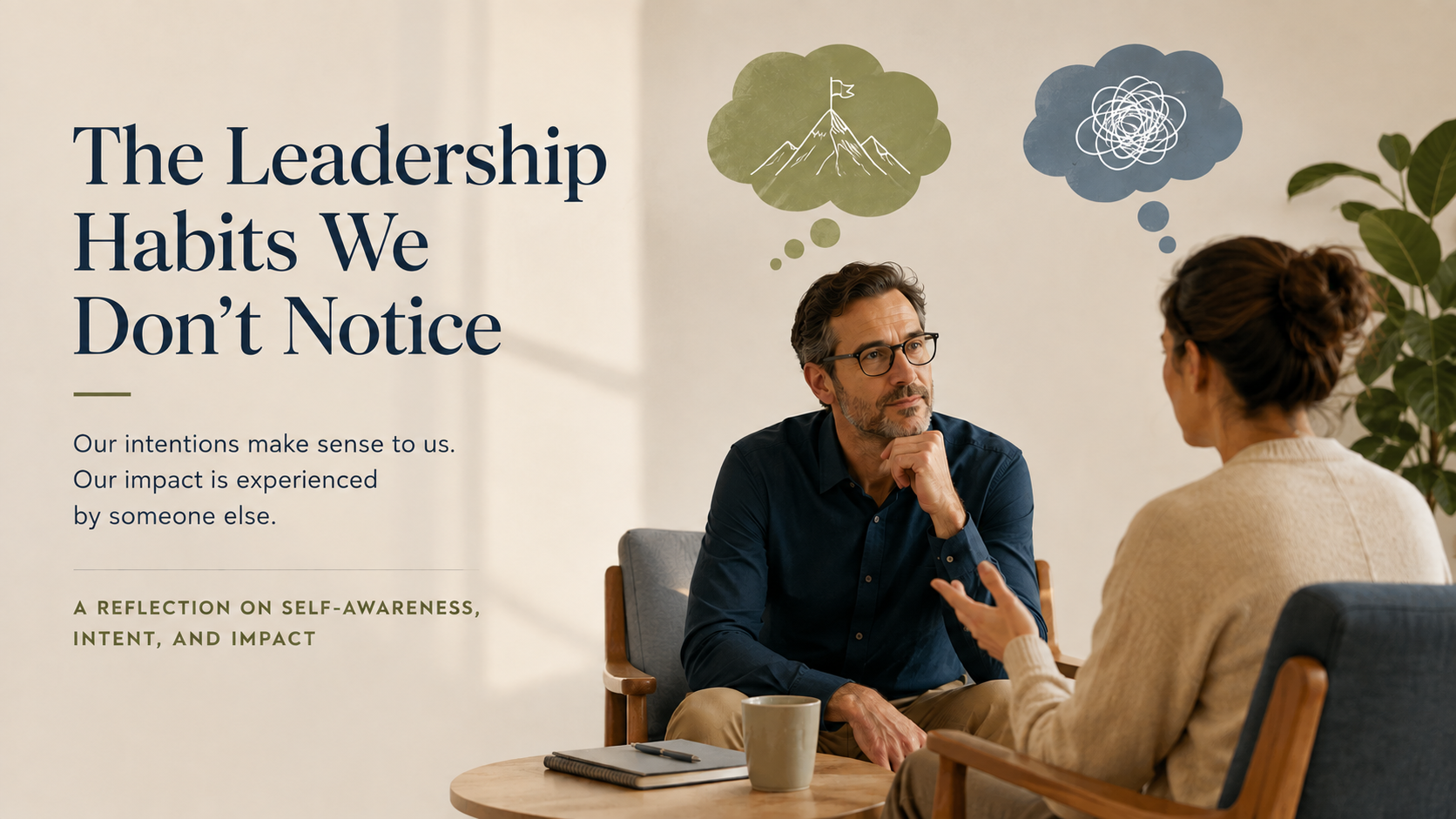
But the people we work with don’t experience our intentions. They experience our behavior.
And sometimes there’s a gap between the two.
Consider some ordinary moments at work:
Someone shares an idea, and you correct a small detail that doesn’t really change their point.
Someone tells you they were frustrated by a decision, and you immediately explain why you made it.
A decision has been made, but you still have concerns, so you continue making the case for a different direction.
A colleague brings you a problem, and you jump in and solve it.
You’re frustrated in a meeting, so instead of saying something you might regret, you become quiet and withdraw.
None of these behaviors is inherently terrible. In fact, each can come from a perfectly reasonable place.
You correct the detail because accuracy matters to you. You explain yourself because you want the other person to understand the context. You keep advocating because you care deeply about the outcome. You solve the problem because you want to help. You go quiet because you’re trying not to make the situation worse.
Our intentions can be good while our impact is something very different.
The correction meant as helpful might feel dismissive.
The explanation meant to provide context might feel defensive.
Persistence meant as commitment might feel like an unwillingness to accept a decision.
Helpfulness might be experienced as a lack of trust.
Restraint might look like disengagement.
This is one of the harder parts of self-awareness: learning to see ourselves not only from the inside, where our intentions are obvious to us, but occasionally from the outside.
These gaps often become larger when we’re under pressure.
Something happens—a colleague challenges us, a decision goes differently than we hoped, someone misses a deadline, we feel ignored or misunderstood—and almost instantly, we make sense of it.
Event → Story → Reaction → Behavior → Impact
The “story” can happen so quickly that we barely notice it.
Here we go again.
They don’t trust me.
I’m going to have to fix this.
Nobody is listening.
Why can’t we just move forward?
That story affects our emotional reaction. Our reaction influences what we do next. And what we do next becomes someone else’s event—something they now have to interpret and react to.
That’s how patterns between people develop.
Over time, we can become very good at noticing the other person’s part of the pattern and surprisingly bad at noticing our own.
When an interaction isn’t going well, our natural questions tend to be about the other person:
Why are they doing this?
Why can’t they see what I’m saying?
Why do they always react this way?
There is another question available to us:
What happens to me in moments like this—and what is it like to be on the other side of me?
That question doesn’t mean taking responsibility for everything that happens between people. It doesn’t mean that every criticism is accurate, every disagreement should end in consensus, or every decision should make everyone happy.
It simply means becoming curious about our own contribution.
Maybe I become more controlling when I’m worried something won’t get done.
Maybe I overexplain when I feel misunderstood.
Maybe I correct people when precision feels important.
Maybe I keep advocating long after people have understood my position.
Maybe I withdraw when conflict becomes uncomfortable.
Maybe I become unusually certain when I actually feel uncertain.
These aren’t character flaws. They’re patterns. And patterns can become choices once we can see them.
Think about yourself when you’re frustrated, under pressure, or disagreeing with someone at work.
What do you tend to do?
What positive intention might be underneath that behavior?
And perhaps the harder question:
How might someone else experience you in that moment?
Leadership isn’t about eliminating every imperfect habit. It is partly about becoming more aware of what we bring onto a team, especially in the moments when we’re least likely to notice it.
Download the 2025 Collective Impact Report to see the data-backed strategy that reduced Turnover Intentions by 13.20% and dramatically improved Psychological Safety in 10 school districts.